Key US Tax Considerations for UK Fintechs

Scale & Grow Partner | Frazier Deeter are a leading CPA and advisory firm offering comprehensive tax, audit, and consulting services in the US and UK.
Key Terms Relevant to US Investors: CFC and PFIC
Expanding into the US market or securing investment from US-based investors introduces important tax considerations that fintechs must navigate.
US tax regulations impose specific reporting obligations and classifications on foreign corporations, which can impact the structure and tax treatment of investments.
Two key classifications that often arise in these discussions are Controlled Foreign Corporations (CFCs) and Passive Foreign Investment Companies (PFICs). Understanding these classifications and their implications is essential for UK fintechs looking to scale into the US.
Controlled Foreign Corporation (CFC): Definition and Key Considerations
A CFC is a foreign corporation in which more than 50% of the total combined voting power or value is owned by US shareholders. A US shareholder is defined as any US person who owns at least 10% or more of the foreign corporation’s stock.
Ownership Attribution Rules
Ownership can be direct, indirect, or constructive, meaning shares held by related parties, such as family members, may be attributed to an individual. This can lead to CFC classification even if no single shareholder holds 10% or more directly.
Tax Implications for US Shareholders
Once a foreign corporation is classified as a CFC, US tax rules impose certain obligations on US shareholders, particularly regarding Subpart F Income and Global Intangible Low-Taxed Income (GILTI).
Subpart F Income: Certain passive and other designated types of income earned by a CFC are taxed immediately to US shareholders, regardless of whether a distribution has been made.
GILTI: Introduced under the Tax Cuts and Jobs Act, GILTI rules require that certain CFC income be included in a US shareholder’s tax return annually, even if no actual distributions occur. The impact varies depending on whether the US shareholder is an individual or a corporation.
Foreign Tax Credits: The treatment of foreign tax credits differs between Subpart F and GILTI. For Subpart F income, a full 100% foreign tax credit may be available and carried forward. GILTI, however, has a 20% haircut, meaning only 80% of foreign taxes paid can offset US tax liabilities, and any unused credits cannot be carried forward.
Why This Matters for UK Fintechs
When working with US investors, fintechs may be required to disclose their CFC status and provide financial data to facilitate investor tax compliance. Understanding these implications can help prevent unforeseen tax burdens and make the investment process smoother.
Passive Foreign Investment Company (PFIC): Definition and Implications
A PFIC is a foreign corporation that meets either of the following criteria:
Income Test: 75% or more of its gross income is derived from passive sources (e.g., interest, dividends, capital gains).
Asset Test: 50% or more of its assets produce passive income or are held for investment purposes.
Unlike CFC rules, PFIC rules apply regardless of ownership percentage. Any US investor holding shares in a PFIC is subject to US tax rules on that investment.
PFIC Taxation Rules
US tax treatment of PFICs is highly punitive compared to CFCs:
“Once a PFIC, Always a PFIC” Rule: If a corporation qualifies as a PFIC in any year, it retains that classification indefinitely, unless certain elections are made.
Distributions: PFIC distributions are taxed as ordinary income, not as qualified dividends, meaning they are subject to higher tax rates.
Excess Distributions: If distributions exceed 125% of the average distributions from the prior three years, they are subject to a special tax regime, spreading the income across prior years and imposing an interest charge on the deferred tax liability.
Sale of PFIC Shares: Any gains from the sale of PFIC shares are treated as excess distributions, leading to interest charges and taxation at ordinary income rates.
Impact on UK Fintechs Seeking US Investment
Fintechs with US investors need to assess whether their business structure could trigger PFIC classification. US investors may be reluctant to invest in a company classified as a PFIC due to the unfavourable tax treatment.
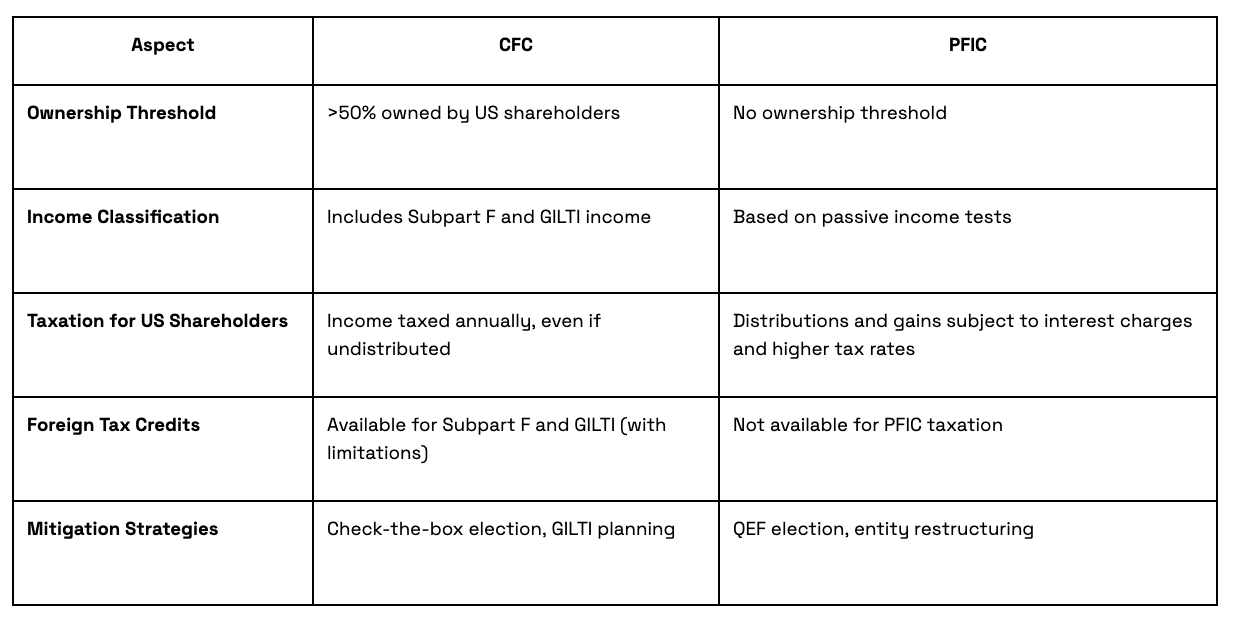
Key Differences Between CFC and PFIC Rules
Strategic Planning Considerations for UK Fintechs
Understanding these classifications and their tax implications can help UK fintechs structure their business operations effectively when scaling into the US. Strategies to mitigate adverse tax consequences include:
For CFCs:
Check-the-Box Elections: This US administrative election allows a foreign corporation to be treated as a pass-through entity for US tax purposes, potentially mitigating CFC-related tax issues.
GILTI Planning: Structuring ownership through a US C corporation can reduce the GILTI tax rate and enable the use of foreign tax credits.
For PFICs:
QEF Election: A Qualified Electing Fund (QEF) election allows for more favourable taxation of PFIC income, eliminating the excess distribution regime.
Corporate Restructuring: Converting a foreign entity into a US domestic corporation can eliminate PFIC status while aligning the structure with US tax efficiency.
Fintechs expanding into the US should assess their classification risks early and seek specialist tax advice to optimise their structure before engaging with US investors.