The (Re)Emergence of Venture Debt: A Strategic Lever for Growth

Scale & Grow Partner Mountside Ventures are Europe's leading accelerator and early-stage advisory firm, optimising all levels of the Venture value chain - from Startups to Funds & Limited Partners.
The (Re)Emergence of Venture Debt: A Strategic Lever for Growth
As valuations tighten and equity funding becomes harder to secure, venture debt has re-emerged as a valuable tool in the startup funding mix. For the right business, it offers a way to fuel growth, extend runway, and avoid premature dilution—all without giving up equity.
This article explores how startups are using venture debt in today’s market, when it makes strategic sense, and what to consider before raising.
What Is Venture Debt?
Venture debt is a type of non-dilutive financing available to startups that have typically raised recent equity rounds. It’s repaid over time from future cash flows, and unlike traditional loans, it doesn’t usually require personal guarantees or hard assets.
This form of funding has become especially relevant in today’s environment, where raising equity at favourable valuations is increasingly difficult.
Strategic Use Cases for Venture Debt
When deployed proactively—not reactively—venture debt can be a powerful growth tool.
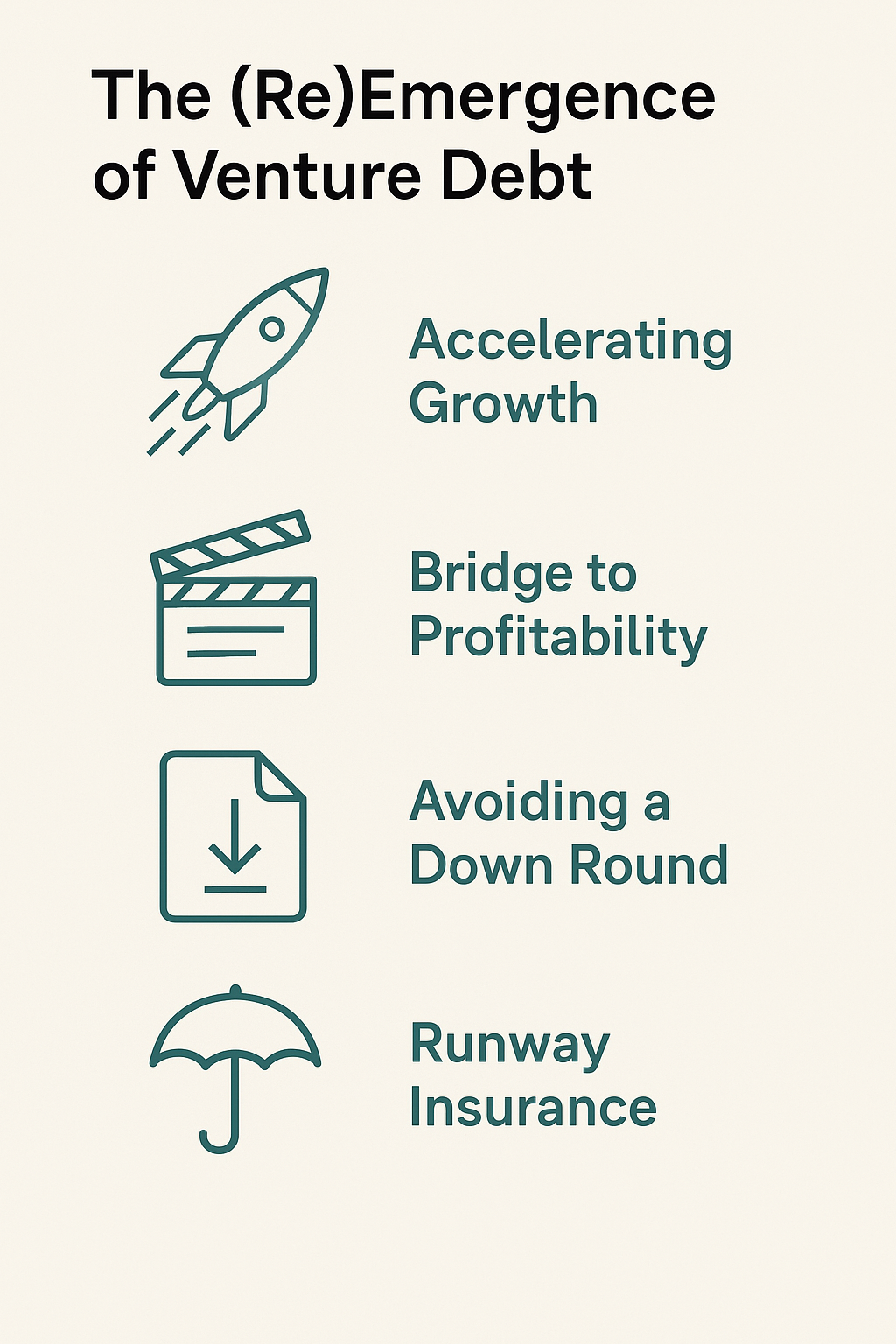
1. Accelerating Growth
Use venture debt to invest in sales, marketing, product development, or international expansion without drawing down precious equity. If these initiatives succeed, they raise your valuation ahead of the next round.
2. Bridge to Profitability
For companies nearing breakeven, venture debt can serve as a final push without the dilution of another equity round.
3. Avoiding a Down Round
Rather than raising a small equity bridge under pressured terms, venture debt can provide interim funding to help hit KPIs needed for a stronger future raise.
4. Runway Insurance
Raising venture debt alongside or just after an equity round can extend runway, giving founders more time to execute and negotiate on better terms in the future.
5. Strategic Acquisitions
For M&A activity, debt can offer the flexibility to pursue opportunities quickly—without relying on equity or delaying execution.
When Venture Debt Shouldn’t Be Used
Venture debt isn’t survival capital. It should not be used:
As a last resort when cash is critically low
Without a clear repayment plan or revenue visibility
If your existing investors aren’t aligned
It works best when raised from a position of financial strength—not weakness.
Benefits of Venture Debt
Non-dilutive: Preserve founder and team ownership.
Fast deployment: Faster to arrange than equity rounds.
Flexible structuring: Tranches and repayment terms can be tailored.
Optimises equity: Enables founders to save equity for future raises or higher valuations.
Risks and Considerations
Repayment pressure: Debt repayments begin regardless of revenue variability.
Covenants: Some agreements may impose financial or operational constraints.
Exit clauses: Understand early repayment penalties or conditions in the event of acquisition or default.
Founders should conduct due diligence on providers and compare term sheets carefully. Not all venture debt is created equal.
Summary: When to Use Venture Debt
Venture debt can help the right startups go further, faster—with less dilution. It’s not a replacement for equity, but a complement to it. For founders with strong investor backing, recurring revenue, and a clear growth plan, it’s an increasingly important part of the capital toolkit.