UK Crypto Regulation: Past, Present and What’s Next

Scale & Grow Partner fscom are a UK-based regulatory compliance consultancy firm that provides services to businesses in the financial services sector.
UK Crypto Regulation: Past, Present and What’s Next
As digital assets continue to evolve, so too does the regulatory framework governing them. The UK’s approach to crypto regulation has progressed significantly in recent years, shaped by global developments, domestic priorities, and shifting political leadership. For businesses operating in the sector, understanding this trajectory—and where it might go next—is key to navigating the regulatory landscape with confidence.
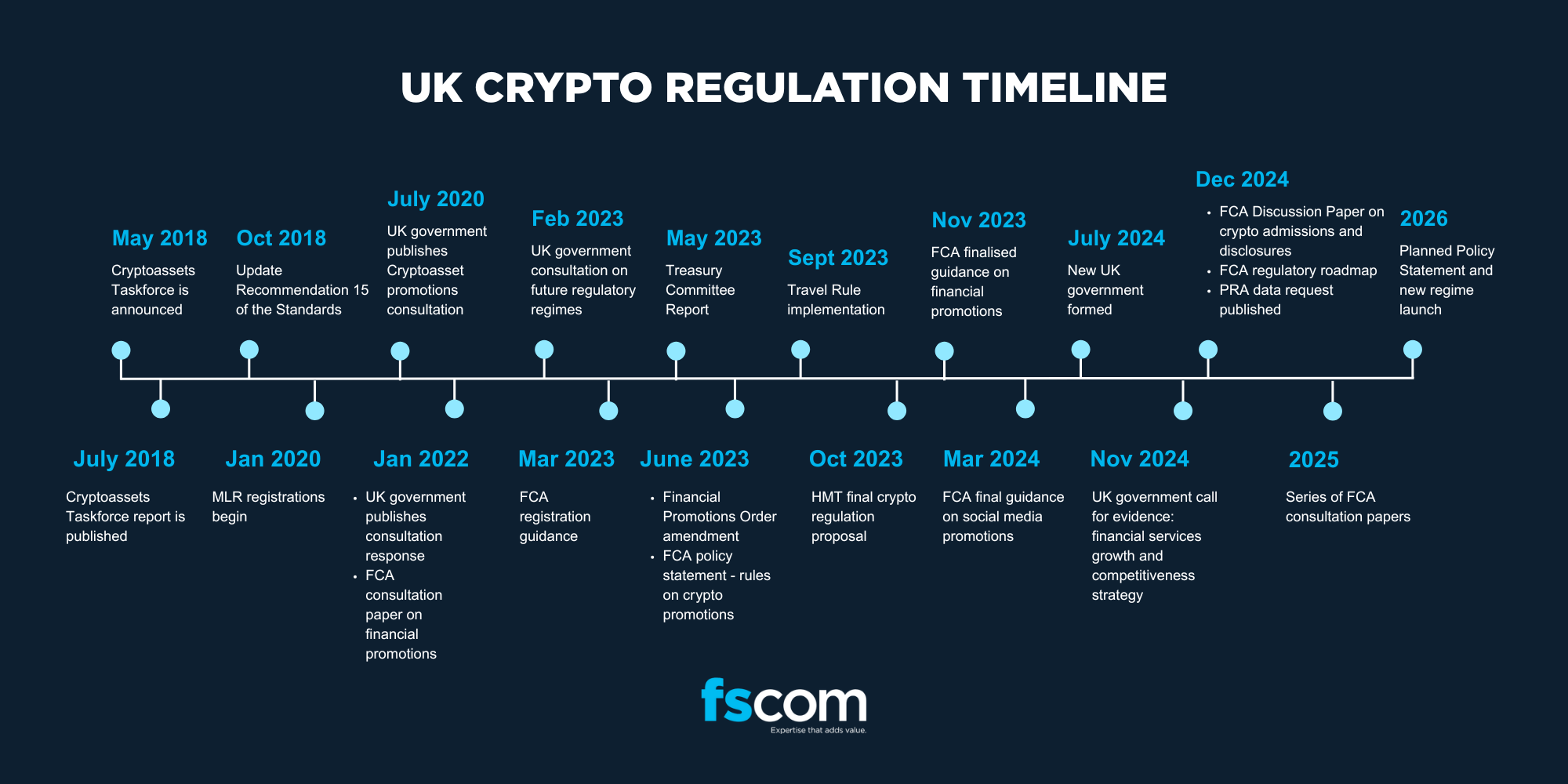
fscom: A Brief History of UK Crypto Regulation
The UK’s regulatory journey began in 2018 with the formation of the Cryptoassets Taskforce, a joint initiative by the Financial Conduct Authority (FCA), Bank of England, and HM Treasury. This marked the country’s first coordinated effort to assess the risks and potential of cryptoassets, focusing on consumer protection, financial stability, and market integrity.
Around the same time, international bodies such as the Financial Action Task Force (FATF) updated global standards to include cryptoasset activities and service providers. These guidelines required countries to monitor, license, and supervise crypto-related firms—shaping the foundation for the UK’s evolving framework.
Subsequent regulatory developments included the UK’s Money Laundering Regulations (MLRs), which required cryptoasset businesses to register with the FCA and comply with anti-money laundering (AML) and counter-terrorist financing (CTF) rules. These early steps reflected a cautious, risk-based approach, focused more on preventing financial crime than fostering innovation.
The Current Landscape
In recent years, the UK has taken notable steps toward a more robust regulatory system for digital assets. Key developments include:
The Travel Rule
Crypto businesses are now required to collect and share sender and recipient information for cryptoasset transfers. This aligns the UK with international AML standards and global enforcement practices.
Financial Promotions
New FCA rules govern how crypto services are marketed to UK consumers. Promotions must be fair, clear, and not misleading. Firms that fail to meet these standards risk enforcement action or being added to warning lists.
Staking Regulations
While staking remains widely used in decentralised finance, UK regulators have raised concerns about consumer risk. Recent clarifications confirm staking is not considered a “collective investment scheme,” removing some legal uncertainty. However, future regulatory proposals may bring staking under the FCA’s supervision, reinforcing a focus on consumer protection.
Political Influence and the Direction of Travel
Policy developments in this space have been closely tied to the UK’s political landscape. A change in government in 2024 introduced new momentum and priorities, with earlier plans for phased crypto regulation replaced by a broader, all-in-one legislative approach.
Previously, the government planned to regulate fiat-backed stablecoins first, before tackling wider crypto market activities. The revised approach aims to introduce a comprehensive cryptoasset framework in a single legislative phase.
Announcements at events such as the City Tokenisation Summit suggest increasing interest in blockchain applications for government instruments (e.g. digital gilts), pointing to a more innovation-led tone. However, there is still uncertainty about how quickly the UK will move, especially when compared to faster-moving jurisdictions.
What’s Next?
The coming year is expected to be pivotal. Upcoming FCA consultations and legislative proposals will address areas such as:
Trading platforms
Intermediation
Lending
Staking services
These efforts signal a shift towards broader oversight, but the timeline and scope remain fluid. While the UK aims to position itself as a crypto hub, it must balance innovation with risk management—and avoid falling behind more agile regulatory regimes elsewhere.
Summary: A Regulatory Crossroads
The UK’s digital asset framework is evolving rapidly. Businesses operating in or entering this space should prepare for a more structured regulatory environment, while staying alert to changes in government direction and FCA policy. As with all areas of financial regulation, clarity and preparedness remain key—especially in a market as dynamic as crypto.