How Venture Debt Helps Founders and Investors Maximise Returns

Scale & Grow Partner Mountside Ventures are Europe's leading accelerator and early-stage advisory firm, optimising all levels of the Venture value chain - from Startups to Funds & Limited Partners.
How Venture Debt Helps Founders and Investors Maximise Returns
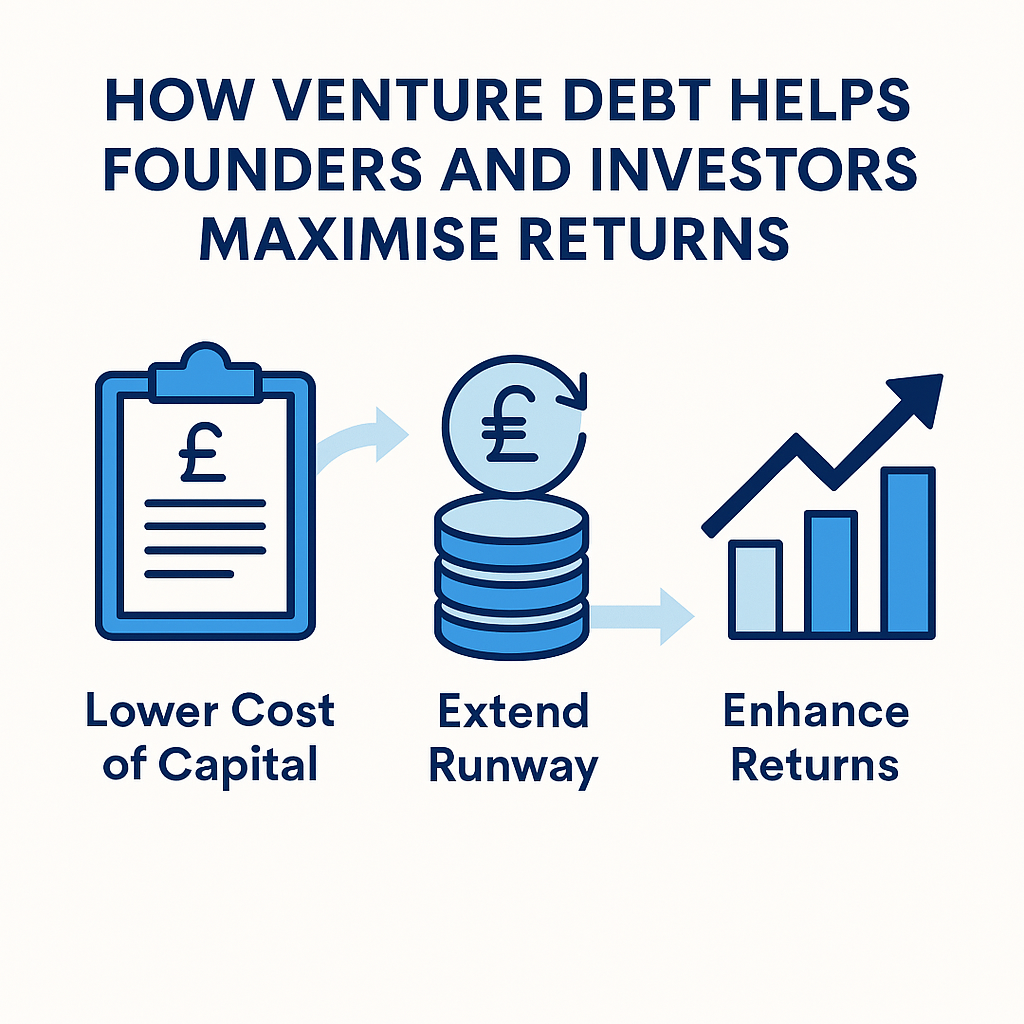
As startups seek capital to scale without unnecessary dilution, venture debt is becoming an increasingly strategic tool in the funding mix. When used appropriately, it offers a lower cost of capital, preserves ownership, and can enhance the returns of both founders and early investors.
This guide outlines how venture debt works, when it’s most effective, and how it compares to traditional equity funding.
What Is Venture Debt?
Venture debt is a form of non-dilutive financing, typically available to startups that have already raised equity from institutional investors. It allows companies to borrow against projected growth and repay as they scale—without giving up additional ownership.
Startups generally use venture debt to:
Extend runway between equity rounds
Accelerate growth
Fund one-off projects
Optimise capital structure
Unlike traditional bank loans, venture debt is often quicker to access and doesn’t require personal guarantees. However, it does come with fixed repayment terms and should be used thoughtfully.
Why Venture Debt Can Reduce the Cost of Capital
Startups typically calculate their Weighted Average Cost of Capital (WACC) to understand how much it costs to access external funds. Since equity capital is more expensive (due to dilution and expected return multiples), combining it with lower-cost debt reduces the overall cost of capital.
Example:
A startup raises £10m entirely through equity → Founders give up 20% equity
Instead, if they raise £7m in equity and £3m in debt → Founders only dilute 14%
Even after repaying the debt with interest, total founder return is higher in the second scenario
This model benefits both founders (more equity retained) and VCs (enhanced IRR).
Key Benefits for Founders
Reduced dilution: Retain more ownership by supplementing equity with debt.
Faster access: Debt facilities can often be arranged in weeks rather than months.
Extended runway: More time to hit key milestones and raise the next round at a higher valuation.
Flexible drawdowns: Borrow in stages based on performance or need.
Strategic Upside for Investors
Higher IRR: Smaller initial equity cheque with the same or higher return on exit.
Capital efficiency: Portfolio companies can achieve more without additional dilution.
Lower risk: Startups may avoid premature down rounds or rushed exits by bolstering their cash position with debt.
Watch-Outs and Limitations
While venture debt has advantages, it introduces fixed repayment obligations that can strain cash flow if used inappropriately. Common risks include:
Overleveraging: Taking on more debt than revenue can support
Restrictive covenants: Operational or financial conditions tied to the loan
Limited suitability: Best suited for businesses with strong revenue visibility and a clear path to profitability
When Is Venture Debt a Good Fit?
Venture debt is best suited to startups that:
Have recently closed a priced equity round
Expect predictable revenue growth
Are within 12–24 months of breakeven or profitability
Need capital for specific, high-impact growth projects
Summary: Optimising Capital Structure
Used wisely, venture debt helps founders scale faster while retaining control, and enables VCs to back more companies without over-concentrating capital. It's not a replacement for equity—but as part of a blended strategy, it can drive better returns for everyone involved.