"The future of British AI is the future of British fintech": the Minister for AI at Fintech Week ...
When the Rt Hon Kanishka Narayan MP opened the Fintech Week London 2026 Summit, he called it a homecoming. Before politics he was a fintech banker and then a fintech investor, and he'd spent plenty of mornings at Fabric long before it hosted a fintech conference.
He has been MP for the Vale of Glamorgan since 2024. After a year as a minister at the Department for Science, Innovation and Technology, he became Minister of State for AI on 20 July 2026, working across the Cabinet Office and the Department for Business, Innovation, Science and Trade. His brief takes in AI Growth Zones and data infrastructure, semiconductors, sovereign AI, the AI Security Institute and the AI Economics Institute.
This time he came as the UK's Minister of State for Artificial Intelligence, giving his first address to the financial services sector since taking on the role. He didn't come with a list of asks. He came to say what government is doing for the industry, and why he thinks fintech is where Britain's AI story will be won. Seven weeks later, the Budget put serious money behind much of it.
"It's important not just to come here and talk to you about all the things that we want off you, but instead to tell you about what we want to do for you in government as well."

Behind the keynote
I was lucky enough to spend time with the Minister away from the stage, talking through his plans for AI and what they could mean for our community. What struck me most was the balancing act. He represents the Vale of Glamorgan, where he spends his weekends talking to people directly about issues like the data centre being built on their doorstep. At the same time, he's carrying one of the biggest briefs in Cabinet.
What I found most refreshing was that he's sat on our side of the table. When he talks about the later-stage funding gap, or how quickly regulation needs to move, he's speaking from experience, not from a briefing note. It's rare to have someone in Cabinet who has done the job.
I came away feeling that AI policy is in a safe pair of hands: someone steeped in practical experience, with a clear view of what founders and investors actually need. That's exactly why I wanted to share what he told us in more detail.
Why British AI is British fintech
His central claim was simple:
"I believe that the future of British AI is primarily the future of British fintech."
The numbers back him up. Britain has around 4,000 fintech start-ups, and fintech takes more than a quarter of all UK venture funding. That's why government made financial services a critical driver of its ambition for the UK to lead on AI adoption. Sector champions from Starling and Lloyds have already drawn up a plan to turn that ambition into reality.
He also thanked the room. Progress in tech, he said, is built by many people together, and the fintech community has helped drive Britain's cultural shift on AI over the past two years.

Where the opportunity sits
The Q&A that followed was hosted by the respected freelance fintech journalist Ian Horne, who also opened the Summit. He handled it deftly, drawing out the Minister on the big picture before opening the floor to sharp questions on everything from how much water data centres use to power AI to the future of graduate jobs. That's how a conversation with a Cabinet minister ended up being so candid and practical.
Asked by Ian for the single biggest AI opportunity in the UK, the Minister admitted to "the classic political thing of cheating" and gave three:
Chips and inference. Britain is strong in new-generation chip design, and inference infrastructure is the next focus.
Frontier models beyond language. Materials discovery, drug discovery and maths models applied in capital markets. "Intelligence is not just about language."
Applications. The quality and pace of adoption depends on how quickly organisations reorganise themselves around AI, and here financial services has "an amazing opportunity".
That third point came up again in the Q&A. Deep adoption, he said, happens when firms draw on the tacit knowledge of their people and rebuild workflows around it, not when they simply buy copilot licences. He noted that employees report using AI at work around 20 percentage points more than their firms' formal licences suggest.
"Be very clear on the rigour of the outcomes that we want, and then work back from the outcome, rather than starting from what model is available today and forcing it into the outcome."
Four levers government is pulling
The Minister framed the government's role around the ingredients of a thriving fintech sector.
Capital. As an investor, he often heard that Britain lacked deep pools of later-stage capital. The British Business Bank is investing more than £20 billion in capital markets, increasingly into tech and fintech, with the focus shifting to growth-stage companies so that businesses "scale and stay here". Its annual investing rate is set to almost double. The Mansion House reforms to how pension funds allocate to equities point the same way.
"Make sure that companies inventing and innovating here scale and stay here as well."
Compute. Making sure entrepreneurs have the compute they need is one of his top priorities. Infrastructure is being built in North and South Wales, the North East and Oxfordshire, so the prosperity it brings is shared across the country.
"It's one of my top priorities that Britain has the level of compute that every entrepreneur in this country requires to build brilliant AI innovations."
Clarity of regulation. He has been working with the Bank of England, the FCA and the Treasury on sandbox environments for agentic payments. These build on the FCA sandboxing that helped the first generation of neobanks emerge, with the aim of making Britain "the fastest place to do agentic payments innovation".
"Making Britain the fastest place to do agentic payments innovation and AI as well."
Talent. The Sovereign AI fund, worth half a billion pounds, backs start-ups building strategically for the country, including Callosum, Ineffable Intelligence and Isomorphic Labs, with more announcements expected. Alongside it, government offers 24-hour visa turnarounds for top talent joining those companies.
He also announced that later that day he would launch a new lab with UCL and Oxford, focused on neurosymbolic models and other world-model approaches. That's a direct answer to a question from the floor about AI that financial services can evidence and trust.
Since the keynote: the Budget puts money behind it
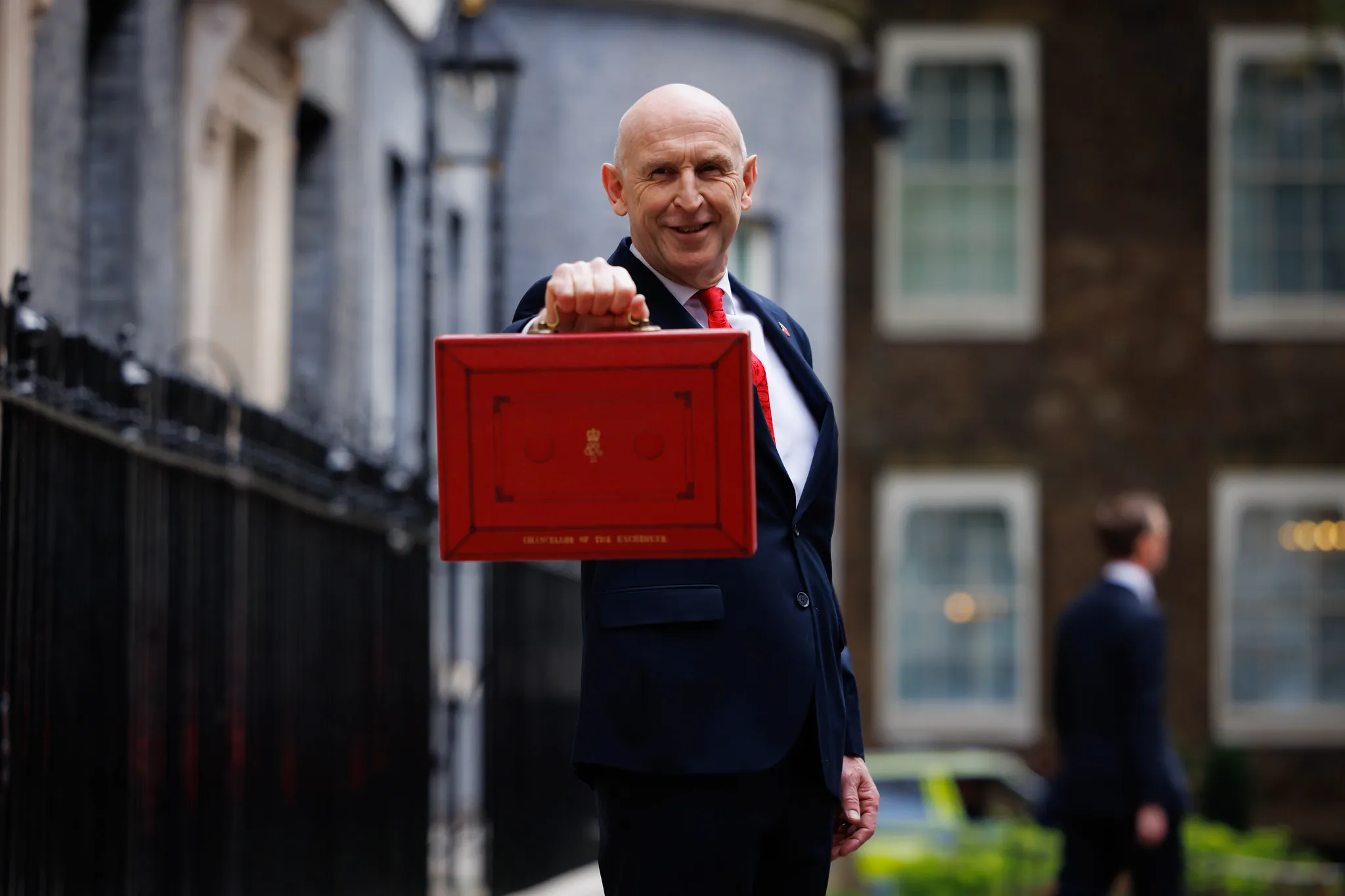
Seven weeks later, Chancellor John Healey made AI part of his first Autumn Budget on 28 October, with a package worth more than £600 million. "AI will transform daily life: every firm, community, hospital, school, and every aspect of our economy can benefit," he said.
The Minister put it in terms that echoed his Fintech Week London keynote:
"As AI becomes more powerful, Britain must have the capabilities to protect its people and shape its own future."
What the Minister said in September vs what government committed in October
Capital: shift the British Business Bank towards growth-stage companies so they "scale and stay here". An extra £5bn for the British Business Bank, taking its capacity to £30.6bn. That covers £1.4bn more for equity funds (mainly scale-ups) and £450m for a new venture debt product. The National Wealth Fund gets £15.4bn, so the combined uplift is over £20bn.
Founders: keep the companies inventing here building here. A new Founders' Relief: a 10% Capital Gains Tax rate on lifetime gains up to £10m, from April 2027 (eligibility still under consultation). EMI2 doubles the tax-advantaged share option limit from £60,000 to £120,000 for staff at companies that have outgrown EMI.
Talent: quicker routes for the very best people into the UK. The High Potential Individual visa extends to graduates of the world's top 150 universities, with the cap raised to match, and the Graduate visa extends to two years for universities with strong outcomes.
Sovereign AI: the half-billion-pound fund backing strategic start-ups. A further £60m for the Sovereign AI Fund to invest directly in UK AI companies, now with a Physical and Industrial AI focus, plus £60m more for Sovereign AI R&D procurement.
Chips and compute: chip design strengths and infrastructure built across the country £18m for a UK Advanced Chip Design Academy and new chip design investment in Edinburgh. A Data Centre Covenant speeds grid connections for strategic data centres that deliver local benefits.
Agentic AI and sandboxes: sandboxes that make Britain the fastest place for agentic innovation. £60m for a National Cyber Shield that uses agentic AI to strengthen cyber defences, including scoping a regulatory sandbox for agentic cyber tools.
Trust and safety: a pragmatic focus alongside ambition. £120m more for the AI Security Institute and £165m for a National AI Biosecurity Initiative.
Jobs: his worry about the first rungs of the career ladder. £23m over three years for the AI Economics Institute to study AI's effect on jobs and living standards, and £30m for local AI partnerships with mayors, including worker AI skills.
For fintech, the biggest prize is the capital. More growth-stage equity, venture debt and a lower tax rate for founders go straight at the later-stage funding gap the Minister described from his investing days. Startup Coalition's Dom Hallas summed it up: "Today is a better day to be building an innovative company in Britain than yesterday." He was just as clear that there is more to do.
There was also a nod to fairer access to capital. The British Business Bank doubled its commitments to women-led businesses and funds to £200m, alongside a new scale-up programme for female founders.
Three things are still to watch for fintech:
Founders' Relief eligibility. The rules are tight and out to consultation. Innovate Finance has called the relief welcome in principle but wants eligibility extended so most fintechs qualify.
Fintech-specific policy. The Budget had little directly for financial services. Stablecoin rules and open finance, both on the industry's wish list, weren't addressed.
The agentic payments sandbox. The sandbox being scoped is for cyber tools. The one the Minister discussed with the Bank of England, FCA and Treasury hasn't appeared yet.
As the Minister put it in September, government wants to be "the best partners for Fintech Week, for fintech and for UK AI". The Budget is a strong start on capital and AI. The fintech community will be looking for the financial services detail next.
A story of agency, and some honest answers
The Minister was clear that Britain's AI story has to be told as well as built. He contrasted the scepticism of the UK and US public with the optimism of countries like India and Indonesia, and set out a third way:
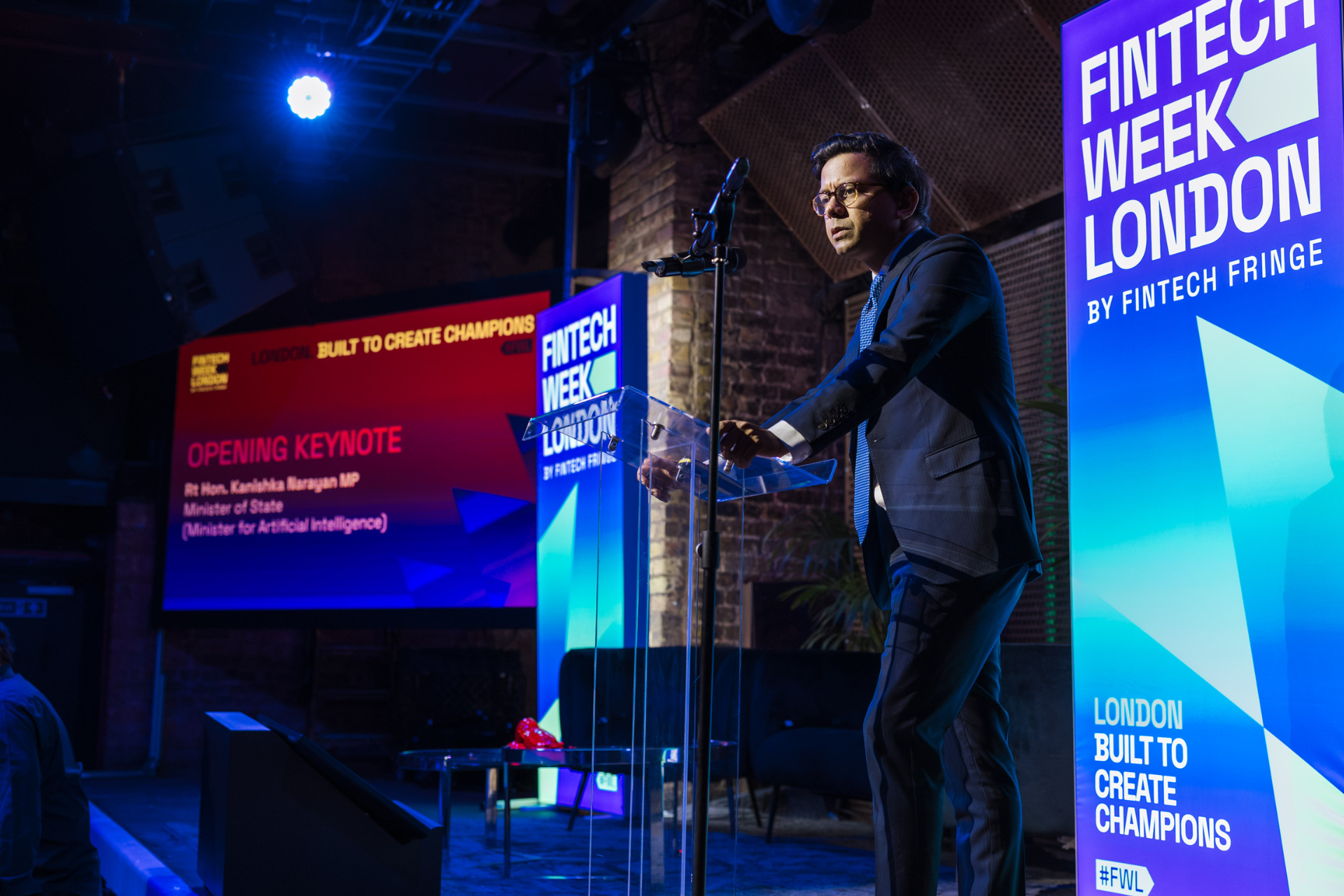
"The story of British AI is a story of agency: of how you build with innovation and pace and ambition, but at the same time build with a very pragmatic focus on trust and safety alongside it."
He said the same about data centres and water use. There are ways to build infrastructure that harm the environment and ways that help it, and "we have agency on that question". The real exam question, he said, is where sovereign infrastructure and climate goals overlap.
"What I'm most worried about is that we approach this conversation with a sense of inevitability. The real exam question is: what is the overlap of those two objectives?"
The most candid moment came when he was asked how young people will build experience if AI erodes entry-level roles. "Really important question, I don't have a great answer, and I'm worried about it," he said. There's little evidence of it happening in the UK yet. But if the first rungs of the career ladder go, firms will need a step change in how they capture and pass on the tacit knowledge that people need to reach the top.
He closed with a call to the room. Britain had a buccaneering past, and there is now a cultural shift, "in nightclubs, in co-working spaces, in pubs", towards seeing fintech as a central driver of national prosperity.
“We are now rolling up our sleeves in government and doing everything we can to be the best partners for Fintech Week, for fintech and for UK AI."
Be in the room for 2027
Fintech Week London returns from 20 to 24 September 2027, with a two-day Summit for 1,000+ senior decision-makers on 21 and 22 September. AI runs through every stage.
Get your pass • Read the 2026 rewind