What fintech founders need to know about storytelling for fundraising
Insights from the April edition of Scale & Grow. Session delivered by Nicky Harrison and Anna Jones, Co-Founders, Nanta Partners.
In this Scale & Grow workshop, Nicky Harrison and Anna Jones of Nanta Partners provided a pragmatic guide to one of the most underestimated skills in a founder's toolkit. From building messaging foundations to understanding the requirements of journalists, they delivered a functional approach to making a narrative work across every relevant audience. Storytelling is not just a marketing task; it is a commercial lever that helps secure funding, attract talent, and drive sales.

Your story works before you enter the room
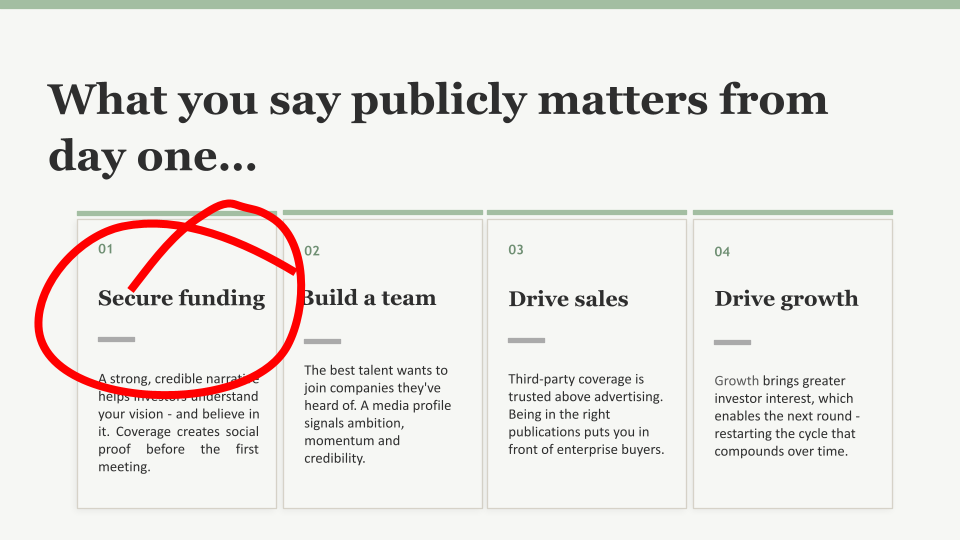
Many founders treat PR and communications as a post-raise activity. This is an operational error. What a founder says in public matters from day one because the narrative is already active. It exists in LinkedIn posts, job ads, investor decks, and early website copy.
A clear story helps investors understand a vision before the first meeting. It signals ambition to high-level talent who want to join recognisable companies. Third-party coverage builds a level of trust that advertising cannot replicate. This growth attracts further investor interest, creating a cycle that compounds over time.
Identifying investable assets
Before a story can be told, a founder must know what they are actually selling. Investors typically assess five specific assets:
The founder and the team.
The market opportunity and its true scale.
Proprietary IP and differentiation.
Data and market traction.
The current relevance or "heat" of the market.
Four questions for messaging foundations
Founders must be able to answer four questions consistently and with conviction:
Who are you talking to? Investors, customers, and talent require different framings of the same truth.
What problem are you solving? Messaging should lead with the problem. Every headline must answer "why does this matter?"
Why does it matter right now? Connect the story to current markets, policy, or cultural shifts. Relevance is the primary metric for editor and investor engagement.
How are you different? Move beyond product features. Identify the specific point of market expertise that only your team can credibly claim.
Messaging Architecture
Messaging should be delivered at the correct level of detail for the moment:
The elevator pitch: One clear sentence covering what you do, for whom, and why it matters. It must be jargon-free and deliverable in under 12 seconds.
The boilerplate: A consistent 50-word paragraph for the bottom of press releases and websites. It follows a simple structure: Problem, solution, why you, traction.
Key messages and proof points: Three to five distinct messages anchored by concrete evidence, such as customer numbers or technical milestones.
What makes news
Journalists receive a high volume of emails, most of which are ignored. Stories that cut through are timely, new, disruptive, or insightful. This means challenging received wisdom in the industry or providing data and perspectives that no one else can offer.
Reputation is not built on a single piece of coverage but on consistency across channels. Earned media provides social proof; owned channels like LinkedIn and newsletters give the founder total control; and shared presence through industry bodies builds the warm networks where investors often find their next deal.
GEO: Generative Engine Optimisation
Search engine optimization is no longer the only digital requirement. Models like Claude, ChatGPT, and Perplexity are already forming opinions about companies. Generative Engine Optimization (GEO) is now a necessary consideration. AI engines surface content from trusted publications and consistent LinkedIn voices. Clear, consistent owned content signals authority to these models - this along with earned coverage is a vital source of training data for AI.

The Scaling Checklist
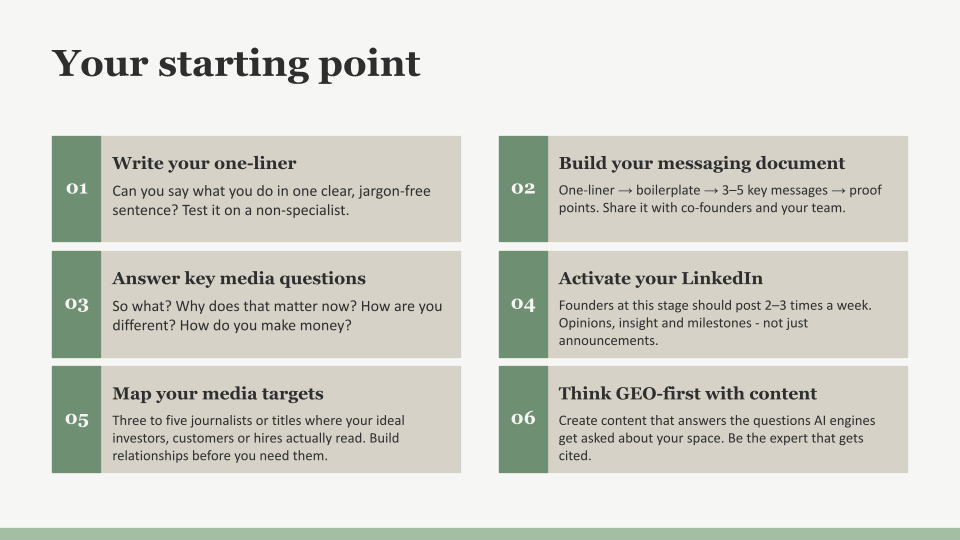
The 12-Second Test: Write your one-liner and test it on a non-specialist. If it is too complex, it will not scale.
Build the Messaging Document: Create a source of truth containing your one-liner, 50-word boilerplate, and 3-5 key proof points. Share this with the entire team.
Media Question Prep: Prepare factual answers for the four key media questions: So what? Why now? How are you different? How do you make money?
LinkedIn Activation: Share opinions and insights 2-3 times a week. Focus on building authority rather than just announcing news.
Target Title Mapping: Identify 3-5 journalists at titles your ideal investors, customers and hires actually read.
GEO Content Creation: Identify the questions AI engines get asked about your space and create content that specifically answers them to signal authority to LLMs.
Proprietary Data Audit: Identify one internal data point or trend that would be interesting to a journalist. Facts are more credible than vision statements.
Want support with your communicating your next raise?
Get in touch with Nicky: nicky@nantapartners.com / Anna: anna@nantapartners.com