The Snowball Effect: Why Your B2B Lead Gen Is Failing, and How to Fix It on a Budget
Your pipeline isn’t stagnant because you’re spending too little. It’s stagnant because you’re making it all about you. Here’s how to build trust at scale without burning cash.
The story is painfully familiar. You’ve spent months building a product that solves a real problem, and yet the pipeline won’t move, the LinkedIn ads get ignored, and the sales team is shouting into a void. The instinct is to spend more. The fix is usually to think differently.
The old playbook – gate a whitepaper, wait for downloads – is effectively dead. When anyone can generate a thousand generic ebooks in an afternoon, information becomes a zero-value commodity. To scale now, founders have to stop behaving like a vendor and start earning the position of trusted authority.
The invisible buyer
The deepest mistake most startups make is assuming the prospect cares about their features. They don’t. Your buyer is consumed by their own targets, their own office politics, and their own survival. Lead generation that ignores that reality is simply noise.
Shift the perspective and the tone of your outreach changes. You stop selling and start solving, which makes you personable, approachable and – the part that matters – useful. Instead of asking for fifteen minutes, you’re handing over an insight they didn’t have before.
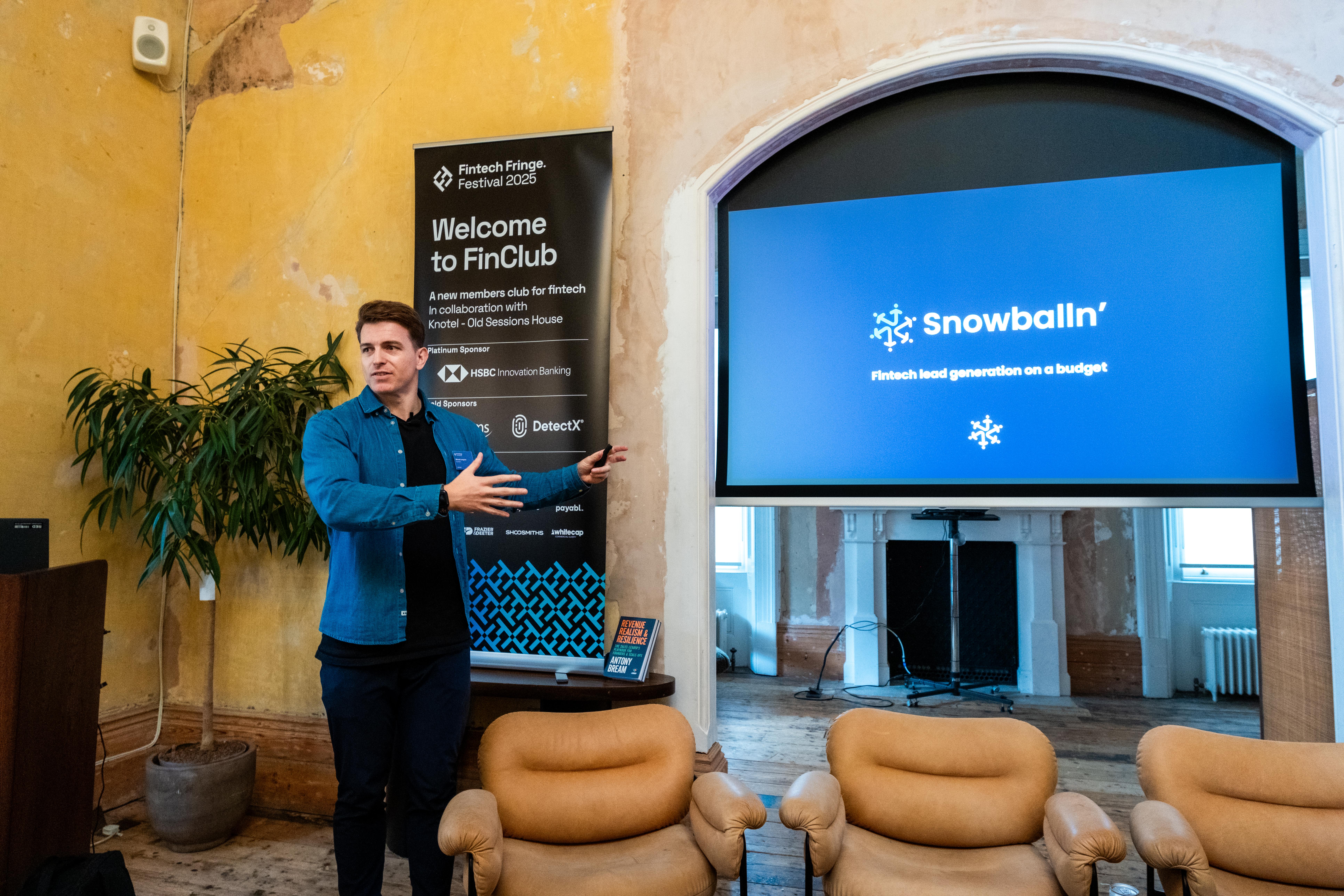
“Nobody cares about you, your business, or your service. What they care about is their business, what they are trying to achieve, and what they are having for dinner tonight. If your lead generation strategy does not start from their reality, you are just noise.”
Michael Lovegrove, Founder, Snowballn
The math of trust: 7-11-4
Trust is the most expensive currency in fintech, and most founders try to buy it far too cheaply. A useful reality check is the 7-11-4 rule: to move a cold prospect to a signed contract, they need around seven hours with your brand, across eleven touchpoints, in four different mediums.
If your current effort is an email and a follow-up call, you’re nowhere near the threshold. Getting there means showing up in video, audio, social and in person, so the prospect feels they already know you before the first formal meeting. That cumulative exposure is the snowball: small, repeated, and unstoppable once it’s rolling.
“You have to spend seven hours with a prospect across eleven touchpoints in four different mediums in order for them to trust you enough to buy. Most founders are giving up after two touchpoints and wondering why their pipeline is empty.”
Michael Lovegrove, Founder, Snowballn
Trade reach for the room
As ads get pricier and less effective, the smart move is to pivot toward high-impact, human-led experiences. Ditch the mass-market webinar in favour of micro-events – picture twelve carefully chosen C-suite prospects around a private dinner table, talking through a specific regulatory headache.
In that room you’re not pitching; you’re facilitating a conversation between peers. By the end of the evening you’ve banked a meaningful chunk of those seven hours, and you’ve gone from a stranger in the inbox to a peer at the table. It’s lead gen on a budget precisely because it trades breadth of reach for depth of relationship.
Narrow to scale
Founders fear that narrowing their focus will cap their growth. The opposite is true: wide is the enemy of conversion. Try to speak to everyone in financial services and you end up in corporate, jargon-heavy language that lands with no one.
Narrow your Ideal Customer Profile to a specific sub-sector – say, Tier 2 building societies wrestling with legacy mortgage migrations – and you can speak their language. Name their exact pain points and regulatory hurdles with enough precision and you stand out instantly.
“If you have nine ICPs, you have zero. You need to go so narrow that you can speak the secret language of your buyer perfectly. Success is about reverse engineering why your best customers bought from you and finding more people exactly like them.”
Michael Lovegrove, Founder, Snowballn
The 60-second superpower
On execution, one tactic punches well above its cost. In an era of automated LinkedIn spam, a personalised 60-second video is a superpower. Reference a specific challenge that prospect is facing and you prove you’ve done the homework – that you’re a human, not an algorithm. For a founder on a tight budget, it costs nothing but time, and human-to-human connection still delivers the highest return going.
The takeaway
Scaling your lead generation isn’t about spending more – it’s about being more relevant. Adopt the 7-11-4 rule, narrow your target until you can speak its secret language, and swap generic content for high-value human experiences. Build the pipeline on trust rather than volume and the snowball does the rest.
The Scaling Checklist
Run a trust audit. Look at your last ten lost leads and ask whether any reached the seven-hour mark – then find where the journey broke.
Prune your ICP. Cut the bottom half of your target list and pour all your energy into the half where your domain expertise runs deepest.
Diversify your mediums. If you only use email, add three more this month: founder-led video, a niche podcast slot, or a curated micro-dinner.
Take the secret-language test. Read your website copy aloud. If it sounds like a brochure rather than a peer talking to a peer, rewrite it.
These perspectives are drawn from a Fintech Fringe talk on B2B lead generation, with Michael Lovegrove (Snowballn).
Get Involved with Fintech Week London
Attend • Exhibit • Speak • Sponsor • Host
B2B lead generation that works is one of the conversations on the The Growth Engine track at this year’s Summit, themed Growth + AI. Fintech Week London runs 7–11 September: five days across the city, built around the two-day Summit on 9–10 September, where founders, investors, operators and regulators come to connect, collaborate and do business in the world’s number one fintech ecosystem.