Fast-Tracking Fintech Innovation: How Banks & Startups Are Changing the Game
Sponsored by SAP Fioneer, rock-solid technology to empower banks, insurance companies and challengers to grow and transform at scale and speed.
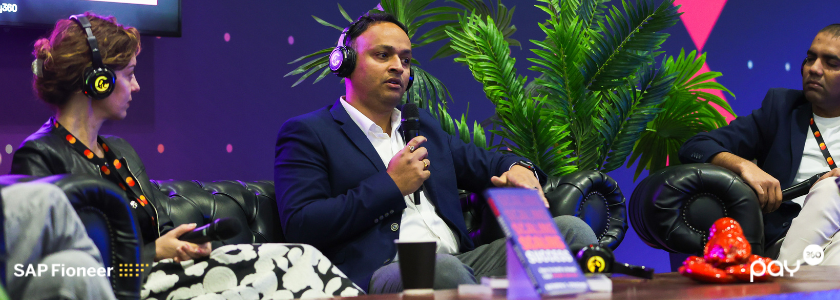
Hosted on the Innovation Stage at Pay360 by Fintech Fringe, this session brought together key voices from both sides of the partnership equation.
Innovation doesn’t happen in silos. Fintech-bank partnerships are moving from lip service to real impact, unlocking new products, speeding up time to market, and navigating regulation more effectively. But progress still depends on cracking the basics: trust, data access, onboarding, and culture fit.
Moderated by Simon Taylor, Head of Strategy at Sardine & Creator of Fintech Brain Food and featuring:
Pinar Ozcan, Professor of Entrepreneurship and Innovation, University of Oxford
Karan Jain, CEO, NayaOne
Ishtiaq M Ahmed, Global Product Lead – Emerging Tech, Innovation & Ventures, HSBC
The panel cut through the noise to share what’s working, what’s not and what fintechs need to know if they want to land big-name bank partners.
What Kind of Partnership Are You Selling?
Not all partnerships are created equal. Karan laid out the different types that fintechs and banks are engaging in:
Co-creation: The ideal scenario—but the hardest to execute.
Open-source R&D partnerships: An emerging category where banks experiment with tech still under development.
Supplier/vendor: Tried and tested, but transactional.
White-labelling: Becoming more common with embedded finance use cases.
While co-creation is the holy grail, it’s often the one banks hesitate on most. The problem? Exposing internal data and brand dilution.
“Co-creation sounds great until a bank realises they might look like a NASCAR—covered in fintech logos. Most don’t want that.”
Pinar Ozcan, University of Oxford
The Data Dilemma
You can’t build products or train models without data, but getting access to it inside banks is a major blocker.
Pinar explained how siloed data across departments makes even signed contracts stall. Fintechs often burn through cash waiting for the promised access.
Karan offered a more pragmatic view: synthetic or publicly available data can help teams get started fast—without waiting months for the “perfect” internal dataset.
“Perfect data doesn’t exist. But with synthetic data, you can get a test environment up fast. It’s not about perfection—it’s about momentum.
Karan Jain, NayaOne
Ishtiaq flagged another bottleneck: even when the innovation team is ready to move, internal resistance from risk, audit, and compliance teams slows everything down.
“Just because one team’s excited doesn’t mean the rest of the bank is. Getting internal buy-in is half the battle.”

The Rise (and Fall) of the POC
Proof of concepts (POCs) used to be the way in. Now, they’re often a red flag—signalling a long-winded process with no real outcome.
Ishtiaq called it “death by POC”, when too many short-term experiments fail to progress to actual implementation.
But Karan countered with a more optimistic take: when managed well, POCs are still valuable.
“We’ve cut POCs down to four to six weeks. If you know what you’re testing and why, you can fast- track adoption. That’s the sweet spot.”
Karan Jain, NayaOne
Speed and clarity are critical. Fintechs need to know which internal stakeholders they’re solving for—and prove value quickly.
Mind the Expectation Gap
Too often, fintechs treat landing a bank partner as a golden ticket. But what looks like a warm intro on the outside is a maze of stakeholder alignment on the inside.
Ishtiaq urged fintechs to dig deeper into the bank’s needs and constraints.
“Founders come in with a vision. But if you haven’t taken the time to understand what I need, your product won’t land—no matter how innovative it is.”
Pinar stressed that listening is underrated but essential. The most successful founders are adaptive and humble—willing to tweak their product and pitch based on what the bank actually wants.
“Passion is great, but it’s useless if you can’t adapt. Listening and problem-solving beat pitching dreams every time.”

Culture Fit and Coaching
Understanding your partner’s culture can be the deciding factor. Banks are complex, regulated institutions, fintechs that ignore that reality won’t get far.
“If you want to co-create, you need to respect and adapt to your partner’s culture. Otherwise, it breaks down fast.”
Ishtiaq M Ahmed
Karan reflected on the unspoken work of coaching fintech founders through the complexity of enterprise sales.
“Founders don’t always know what the inside of a bank looks like. We spend a lot of time helping them navigate that reality because understanding it is what makes or breaks the deal.”

Practical Takeaways
Start fast, don’t wait: Use synthetic or public data to prototype early.
Define the partnership type: Be clear. Are you a vendor, a collaborator, or a co-creator?
Cut the fluff: No one needs another POC unless it’s solving a life. Define the problem in under six weeks.
Map the bank’s structure: Success depends on knowing who owns what and where resistance lies.
Act like a partner, not a pitch deck: Banks want solution-driven, adaptable fintechs, not rigid dreamers.
Coach your team: Everyone, not just the founder, needs to understand the enterprise mindset.