Develop an AI-Enabled Revenue Engine: Marketing, Sales and Customer Success
For most fintechs, AI still lives in the content bucket. The firms pulling ahead are the ones pointing it at the commercial machinery – and connecting marketing, sales and customer success into one engine.
For a lot of fintech leaders, AI gets used to draft an email or spin out a social post, and rarely touches the core commercial machinery. That’s the missed opportunity. The real power sits in revenue operations: a unified approach that uses AI to connect marketing, sales and customer success into a single, high-performance engine – the central nervous system of a scaling business, not a creative novelty.
From content to commercial intelligence
The numbers are a wake-up call for laggards. Around 45 percent of financial services firms now use AI in some form, but many are still pasting chatbot output into their CRM by hand. Move to a systematic, automated framework and the results get measurable: firms running AI on a proper data governance framework report a one-third cut in customer acquisition cost and a 72 percent improvement in cross-sell and up-sell. The machine doesn’t just write the email – it tells you who to send it to and when they’re most likely to buy.

“ The goal is not just to produce more content. It is to use AI to gather intelligence. By using behavioral analytics and intent tracking, we can move from a scattergun approach to a highly targeted growth strategy. AI should be making you money, not just saving you time.”
Sheila Mitham, Co-CEO, Inbound Fintech
Fix the “trash in, trash out” data problem
The biggest block to an AI revenue engine is messy data. Most fintechs run fragmented stacks where sales uses one tool, marketing another, and the records are duplicated or out of date. Scaling means prioritising data normalisation – using AI agents to clean the CRM, dedupe records and enrich lead profiles in real time. If the data isn’t reliable, the AI output is useless. A single source of truth is the only foundation a revenue engine can be built on.
“You have to go backward before you can go forward. Most companies have big data leaks in their funnel because their tech stack is disjointed. An AI-enabled engine requires a unified stack where every department sees the same customer journey in real-time.”
Sheila Mitham, Co-CEO, Inbound Fintech
The rise of the sales agent
One of the most practical uses is giving time back to the sales team. Sales professionals often spend only 27 percent of their day actually selling; the rest goes on admin and research. Research agents and prospecting agents scan the market for triggers – a target landing a new funding round, say – and pre-fill the CRM with relevant talking points, so a salesperson walks into a meeting with a warm lead and a real grasp of the prospect’s problems, without hours of manual digging.
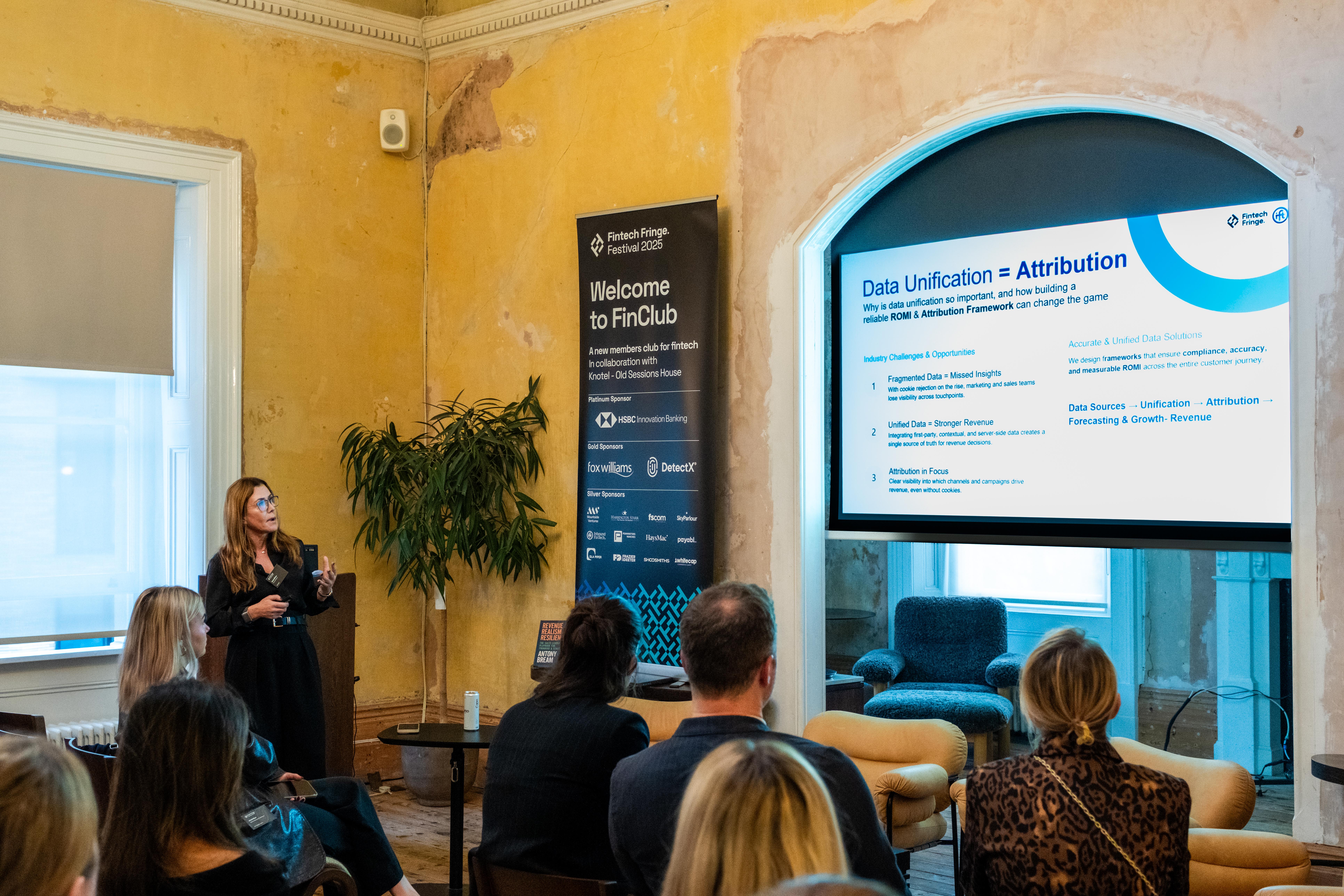
“We are moving from sales enablement to AI enablement. You can have a team of agents doing the heavy lifting of research and lead scoring 24/7. This does not replace the salesperson; it allows the salesperson to focus entirely on closing deals.”
Sheila Mitham, Co-CEO, Inbound Fintech
Keep ethics in the loop
In a regulated industry, autonomous AI can’t be left to its own devices. The human-in-the-loop model – AI assists the decision, a human owns the final output – is what keeps algorithms bias-free and the firm on the right side of the regulator. Build AI by design and your scaling stays sustainable and defensible.
The takeaway
An AI-enabled revenue engine is about unification. Fix the data fragmentation, use agents to take the admin burden off selling, and tie every automated step back to a clear commercial metric – and you can scale revenue without scaling headcount in lockstep. AI isn’t a marketing tool any more; it’s the engine for the whole commercial side of the business.
The Scaling Checklist
Audit the CRM. Run a data-health check this week. If more than 10 percent of records are duplicates or missing key fields, your AI strategy will struggle.
Find the admin tax. Ask your sales team how many hours go on manual prospect research. Target that task for your first AI agent.
Track intent. Move past basic website hits – use AI to read intent signals across the web so your team knows who’s actually in a buying cycle.
Set a human-in-the-loop policy. Document which AI-led decisions need human sign-off. It protects the brand from bias and keeps you compliant.
These perspectives are drawn from a Fintech Fringe masterclass by Sheila Mitham, Co-CEO of Inbound Fintech.
Get Involved with Fintech Week London
Attend • Exhibit • Speak • Sponsor • Host
Building an AI-enabled revenue engine is one of the conversations on the Growth Engine track at this year’s Summit, themed Growth + AI. Fintech Week London runs 7–11 September: five days across the city, built around the two-day Summit on 9–10 September, where founders, investors, operators and regulators come to connect, collaborate and do business in the world’s number one fintech ecosystem.