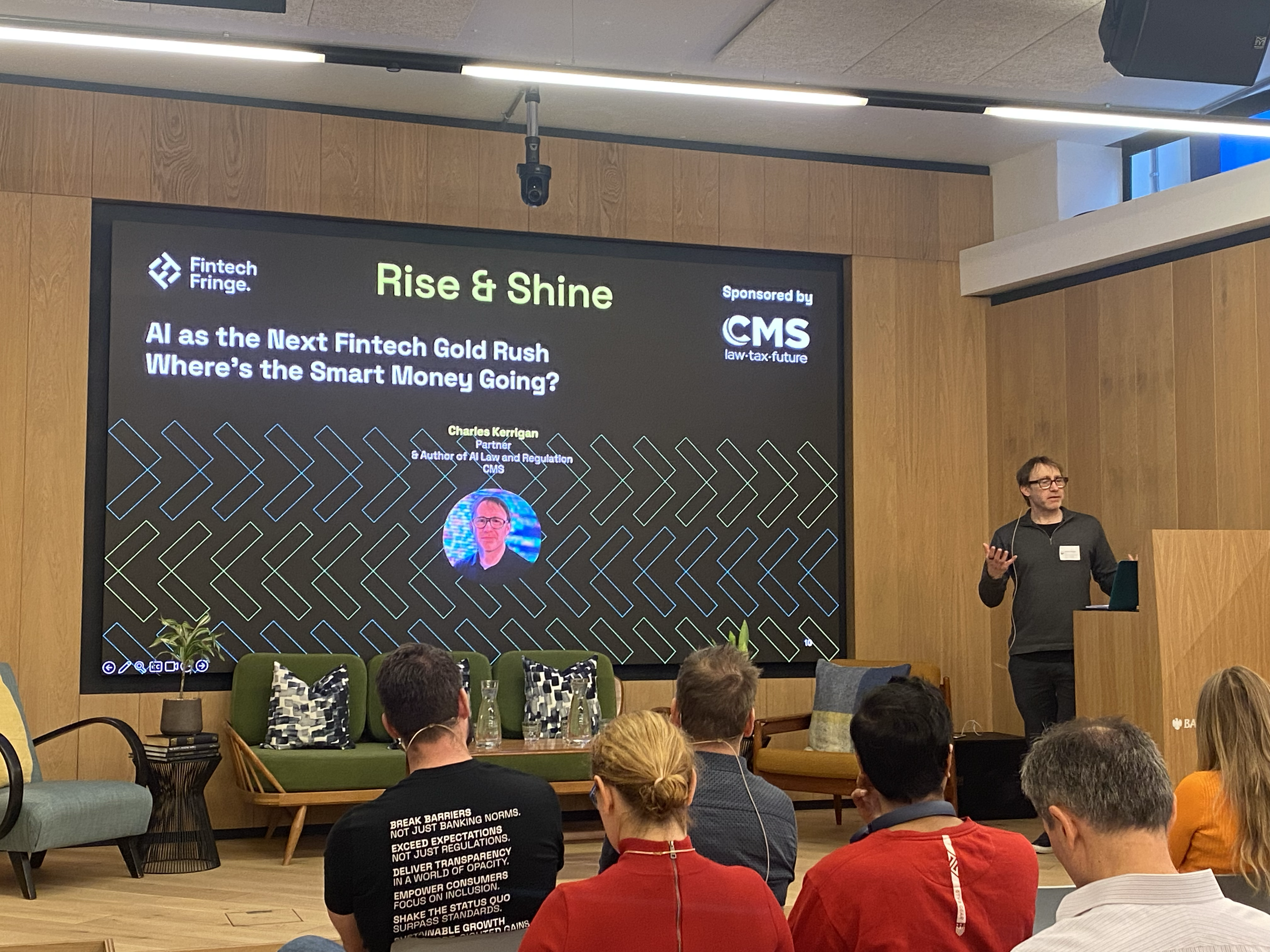
AI as the Next Fintech Gold Rush
Sponsored by CMS - Whether you're scaling, closing a strategic investment, or navigating complex compliance requirements, their fintech team helps you move fast with confidence.
May 2025: Insights from Scale & Grow by Calypso Harland, Founder, Fintech Fringe
What VCs, founders, and fintechs need to know about the next AI shift
In this keynote, Charles Kerrigan, Partner at CMS and author of AI Law and Regulation, pulled back the curtain on how AI is reshaping fintech investment. From warped valuation logic to the rise of data-first business models, Kerrigan gave a fast-paced overview of what’s driving capital allocation today, and what founders and investors need to watch next.
This wasn’t a hype piece, it was a reality check on where venture capital is flowing, what makes AI business models fundable, and why regulation might be the next big differentiator
AI isn’t just another hype cycle, it’s reshaping how businesses are built, how capital flows, and how users interact with financial products. This keynote broke down where the smart money’s going, what’s changing under the surface, and what fintechs should be paying attention to.

1. AI is changing the business model for venture capital
Traditionally, VCs fund teams. Now? AI means teams are smaller-and burn rates are slower.
“Founders used to raise to hire people. Now they’re testing if AI can do the job first.”
That means longer runways and more time between rounds. For VCs, that’s a shift in capital deployment. For founders, it’s a chance to do more-with less.
2. Proprietary data is more valuable than proprietary models
Specialist LLMs keep getting beaten by the next general-purpose release.
Why? Because models don’t win, data does.
“It’s not the model that matters. It’s the training data.”
If your startup controls a valuable, proprietary dataset, you’re playing a strong hand. Trying to build a new foundation model? Prepare for eye-watering costs and even tougher differentiation.
3. Valuation math is changing
Capital-intensive AI startups are warping early-stage valuation norms. A founder offering 20% equity at Seed with a $100M raise? That’s a $500M valuation-day one.
“Some AI valuations aren’t based on price. They’re based on what it costs to build.”
It’s not traditional market logic. But it’s happening-and it’s reshaping expectations for both founders and investors.
4. Why GenAI matters more than predictive AI ever did
Yes, finance has used predictive models for years (fraud, credit, etc.). But Generative AI changes two major things:
Unstructured data becomes an asset. Banks are swimming in it-and now it’s monetisable. Expect new models to emerge from firms that can translate internal mess into bottom-line value.
The interface has changed. We’ve moved from search to answers. And that means founders now need to build for users who have AI themselves.
“Every business model now has to reckon with the fact that all its customers have AI.”
5. AI adoption is a competitive advantage
Fintechs have an edge. They’re faster, leaner, and less tied down by legacy systems.
“Fintechs are better at using AI than banks. Sorry, but it’s true.”
That’s not just a nice-to-have, it’s a strategic advantage. Banks will need to evolve. Partnerships with AI-native infrastructure firms will help bridge the gap.
6. Regulation is coming for AI-and it’s specific
Financial regulators are watching two things closely:
Explainability: If AI makes decisions for customers, firms must show how those decisions were made. Black-box models won’t cut it.
Privacy: As models get smarter, they need less data to identify individuals. That makes privacy harder-and more important.
“Founders who can build privacy-aware AI systems will be building successful businesses.”
Final thought
We’re not just witnessing the rise of a new technology. We’re seeing a structural shift in how financial services are built, scaled, regulated-and funded.
The next fintech wave will be AI-native by default. The only question is: who’s ready to build for it?